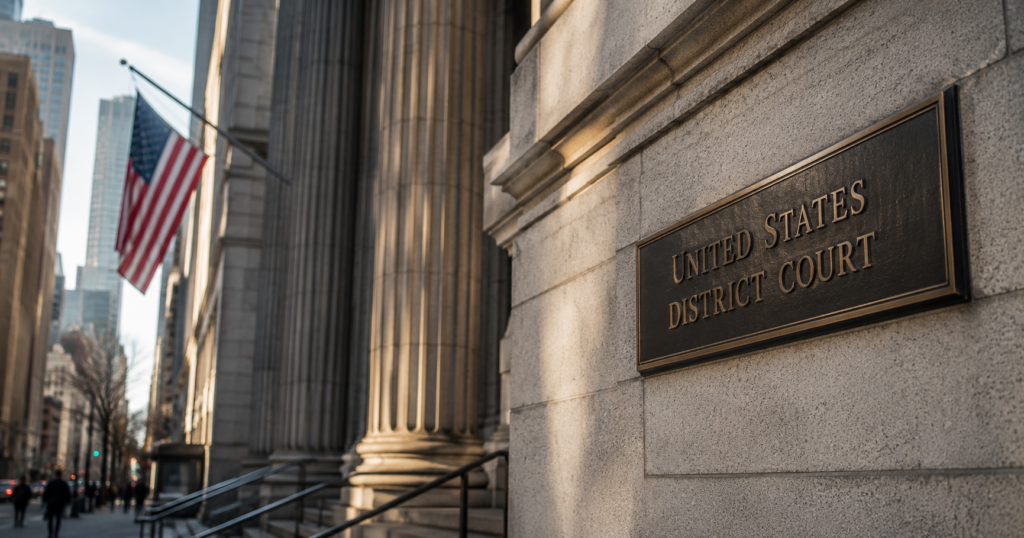
A federal judge in Manhattan has denied the CFTC and DOJ’s emergency request for a temporary restraining order against New York, marking another setback for the federal preemption push on prediction markets.
The federal government’s attempt to slam the brakes on New York’s crackdown on prediction markets just hit a wall.
Last week, Judge Victor Marrero of the Southern District of New York denied the Commodity Futures Trading Commission and Department of Justice’s emergency motion for a temporary restraining order against state regulators from enforcing state gambling laws against federally regulated event contract platforms like Kalshi and Polymarket while the broader injunction fight plays out.
That decision sends a clear signal that the SDNY is not ready to treat federal commodities law as an automatic shield against state gambling enforcement. It also deepens the split in a growing patchwork of rulings around the country, where state regulators fight for jurisdiction over the prediction markets industry.
The SDNY denial comes the same week New York sued Kalshi for running an illegal gambling operation. That came after the US Court of Appeals for the Second Circuit denied Kalshi’s request for an injunction looking to stop the state from enforcing its rules.
What happened in New York
In April, the CFTC sued New York to block the state restrictions on prediction markets. The CFTC asked Marrero for a temporary restraining order to stop New York from pursuing enforcement while the court considers a preliminary injunction.
They told the court that without immediate relief, the state could treat federally regulated event contracts as illegal gambling and slow or shut down business before the court resolves the underlying legal question.
The SDNY already denied Kalshi’s separate bids for an emergency injunction and refused to block the New York State Gaming Commission from enforcing state law against the platform.
Now, with the CFTC and DOJ stepping in on their own case against New York’s regulators, the court has again declined emergency relief, signaling skepticism that the federal claims are strong enough to justify extraordinary intervention at this stage.
The court could take up a motion to reconsider on Friday. For the moment, however, state regulators still have room to act, and the CFTC’s preemption theory has yet to win a clean victory in New York.
The broader prediction markets preemption fight
New York is only one front in what has become a multi-state legal campaign. Over the past few months, the CFTC, often joined by DOJ, has sued a series of states that moved against prediction markets like Minnesota and Wisconsin.
Earlier this year, the CFTC also helped lead federal suits against Arizona, Connecticut, Kentucky, Illinois and Rhode Island, over state-level attempts to treat certain prediction products as unregulated sports bets rather than CFTC-regulated event contracts.
The agency argues that once a platform is registered and its contracts cleared under federal law, states cannot re-label those contracts as gambling and shut them down.
State officials, backed by a coalition of attorneys general from dozens of states, have pushed that they retain authority to regulate or ban prediction markets under local gambling and consumer protection laws, especially when contracts look like sports betting or political wagering.
Split results in Minnesota and Wisconsin
The rulings so far are all over the map:
There are also multiple cases on appeal between states and Kalshi that appear to be shaping up for a final ruling by the U.S. Supreme Court.
The result is that prediction markets now live inside a patchwork. The SDNY denial doesn’t resolve the preemption question, but it adds another data point that federal courts are not rushing to embrace the CFTC’s most aggressive view of its authority.
What this means for operators and traders
For platforms like Kalshi and Polymarket, the legal risk is still very state-specific. The CFTC is all-in on defending federally registered event contracts. Courts are divided on whether those contracts sit safely inside federal jurisdiction or still overlap with state gambling laws.
For traders, the impact is more indirect but real. Legal uncertainty can limit what contracts are offered, where they’re available, and how long platforms are willing to keep them listed when state regulators threaten enforcement.
New York’s stance matters because of the size of its market and its influence on other regulators.